


Every finance leader evaluating outsourcing eventually asks the same question: what will this actually save us? The answer is usually delivered as a sales claim, which is exactly why it deserves a proper breakdown. This article compares the true cost of running SAP FI/CO (Financial Accounting and Controlling) with an in-house team against outsourcing it to an established BPM provider – including the costs that never appear on a salary sheet, and the situations where keeping the work in-house remains the right call.
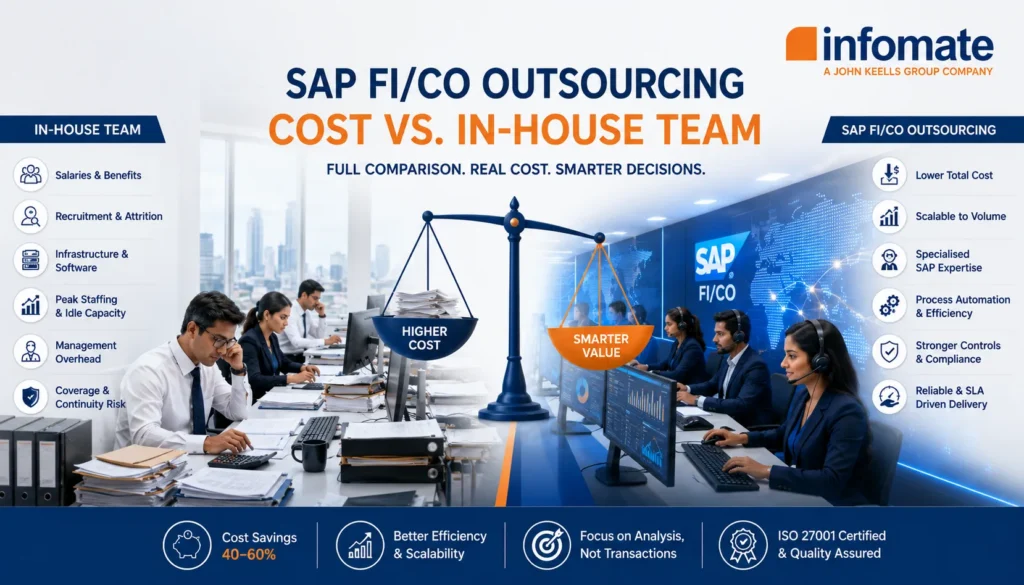
Quick answer: For most organisations in high-cost markets, outsourcing SAP FI/CO processing reduces the total cost of the function by 40-60% – driven less by hourly-rate arbitrage than by shared infrastructure, workflow automation inside SAP, and staffing to volume rather than to peak.
The real cost of an in-house FI/CO team
The visible cost of an in-house team is salaries. The real cost is larger. A fair comparison must include fully loaded employment costs (benefits, pension contributions, payroll taxes, and paid leave typically add 25–40% above base pay), recruitment and attrition (replacing a qualified SAP-fluent accountant takes months, with vacancy periods falling on the remaining team), management overhead, infrastructure and software seats, and peak capacity — teams are usually staffed for month-end and year-end peaks, which means paying for slack the rest of the cycle. Add coverage risk: sick leave, resignations, and single points of failure where one person holds the process knowledge.
How the same work is priced when outsourced
An outsourcing arrangement converts most of the above into a single predictable service fee – per transaction, per FTE-equivalent, or a fixed monthly retainer with volume bands. The provider absorbs recruitment, training, coverage, infrastructure, and management, and spreads those costs across many clients.
Side-by-side comparison
The percentage range is deliberately broad. Savings sit at the higher end when the comparison is a UK, Australian, US, or Gulf cost base and the work is transactional at volume. They sit at the lower end – or disappear – when volumes are very small, the work is mostly judgement-heavy analysis, or the internal comparison is already a low-cost location.
| Cost element | In-house team | Outsourced to a BPM provider |
| Salaries and benefits | Full local employment cost, loaded 25–40% above base | Included in service fee at offshore cost base |
| Recruitment and attrition | Borne directly; vacancies disrupt the close | Provider’s responsibility; continuity contractual |
| Training and SAP upskilling | Ongoing internal cost | Provider maintains platform expertise |
| Infrastructure and software seats | Office space, hardware, licences per head | Shared across the provider’s operation |
| Peak / trough staffing | Staffed to peak; idle capacity off-peak | Scales with volume; you pay for throughput |
| Supervision | Finance management time diverted to oversight | Team leadership included; SLA-governed |
| Coverage and continuity | Leave and resignations create gaps | Cross-trained teams; documented
processes |
| Control environment | Depends on internal discipline | With certified providers: ISO 27001-audited controls, segregation of duties enforced in SAP |
| Typical total cost | Baseline | Commonly 40–60% below the in-house cost baseline for high-cost markets |
Beyond the fee: what the comparison misses
Cost opens the conversation; it is rarely why engagements last. Organisations that outsource SAP FI/CO often discover that the greatest value comes not only from reducing costs but also from improving how they use their existing SAP environment. Optimising workflows, reporting, and automation can significantly increase the return on investment, as explored in our article on unlocking the untapped power of SAP.
Control quality: an established provider runs FI/CO inside your SAP environment under enforced segregation of duties and, with certified providers, an externally audited security framework – often a stronger control environment than the in-house alternative.
Close reliability: providers live by SLA-bound close calendars; a close that lands on day three every month has real value to a CFO before the cost line.
Scalability: acquisitions, new entities, and volume growth are absorbed by the provider’s bench rather than a hiring cycle
When in-house still wins
Keep FI/CO in-house when transaction volumes are genuinely small; when the role is inseparable from business-partnering work requiring physical presence; when data sovereignty rules prohibit offshore processing; or when your SAP environment is so heavily customised that knowledge transfer would outlast the contract. A good provider will tell you this in the scoping conversation – treat that honesty as a selection signal.
Key takeaways
- Compare fully loaded costs, not salaries: benefits, attrition, management time, infrastructure, and peak staffing typically add far more than teams expect.
- A 40–60% total cost reduction is the commonly observed range for high-cost markets; verify it against your own volumes in scoping.
- Control quality, close reliability, and scalability often outweigh the fee difference over a multi-year engagement.
- In-house remains right for low volumes, judgement-heavy work, and data-sovereignty constraints
Frequently asked questions
Does outsourcing FI/CO mean losing control of our finances? No – the work is performed inside your SAP system, under your chart of accounts and approval workflows, with every action logged to an identifiable user. You retain ownership of policies and sign offs; the provider executes within them.
How long does transition take? For a standard FI/CO scope, knowledge transfer and parallel running typically take two to three months, depending on documentation quality and entity count.
What happens to our existing team? Most clients redeploy retained staff toward analysis, business partnering, and review, while transactional processing moves to the provider.
How is quality guaranteed? Through contractually defined SLAs (accuracy, turnaround, close timeline), monthly service reviews, and the provider’s own quality framework – Six Sigma-based discipline and ISO-certified quality and security management at the established end of the market.
Conclusion
The cost case for outsourcing SAP FI/CO is real, but it is a total-cost case, not a salary comparison – and the strongest engagements are the ones where control quality and close reliability, not the fee, become the reasons to stay. Run the comparison honestly against your own volumes, and insist any provider does the same.
Ready to run the numbers for your own operation? Infomate, a John Keells Group company, has delivered SAP-based finance and accounting outsourcing for two decades, serving clients across four continents. Request a scoping conversation at www.infomateworld.com or write to [email protected]