



By Jehan Perinpanayagam, CEO, Infomate (Pvt) Ltd
Short answer: Effective BPO quality management is not an audit function bolted on at the end. In our experience it rests on four things working together: a defined quality framework for every individual process, measurement granular enough to show which defects occur where and why, a culture in which zero defects is treated as the target rather than an aspiration, and the right balance between automation and people. Most providers can describe a quality process. The question worth asking is whether they can show you the data it produces.
Where our BPO quality management began: accuracy
Service quality was brought home to us in the earliest days of Infomate, 21 years ago.
At that point we were a pure captive, serving the John Keells Group, and accuracy in what we delivered was a central ask from our customer. There was nowhere to hide. If a number was wrong, the people who noticed were colleagues in the same group, and they expected it to be right the first time.
What we did about it became the foundation of our BPO quality management, and it has shaped everything since.
Defining what quality actually means
The first thing we did was define quality — and that matters more than it sounds.
People talk about quality very loosely. It appears in proposals as a value rather than a specification. We went in the opposite direction and defined a quality framework for every different function and every different process we ran. Not quality in general: quality for accounts payable, quality for reconciliations, quality for each distinct piece of work.
Within each of those, we mapped the opportunities for defects. Where in this process can something go wrong, and what would it look like if it did? That mapping fed a risk profile for each process, and a newly constituted quality control team carried out audits against it — identifying defects before the work reached the customer, rather than after.
Measurement: sampling, queues and defect data
The sampling approach was risk-based from the start. A new engagement, or one where problems had been reported, was checked at 100%. As a process stabilised, the sample came down to around 20%. We worked with stratified samples rather than flat ones, so the checking effort concentrated where the risk actually sat.
We also built the quality step into the workflow itself. Once a transaction was processed, it moved automatically into a quality queue, and the check was performed there. Quality was not something that happened if someone remembered to do it.
Every finding was recorded and reported. That gave us more than audits — it gave us metrics. We could see what the defects were, in which function they occurred, who made them, and which ones kept recurring. Alongside that we tracked customer satisfaction scores and customer complaints, so internal measurement was always set against the client’s own experience.
Effective BPO quality management is a combination of process, risk management and data about the process. Any one of those alone is insufficient.
What we did with that data mattered as much as collecting it. Quality teams and operations held weekly calibration meetings to review findings and make sure both sides read them the same way, and the sampling rates were then adjusted according to what the findings showed. Information was shared daily, so everyone knew where we stood rather than learning at month end.
And performance-based pay was linked to quality. Where quality was paramount for a particular engagement, we increased its weighting in the performance calculation, so that individual goals and client expectations pointed in the same direction.
From a metric to a culture
Since those early days, our thinking has broadened considerably. BPO quality management stopped being something the quality team owned.
It now extends across the organisation, including in places that have nothing to do with client transactions. Our meetings are expected to reflect it — starting on time, keeping to the time allowed, minutes formatted properly. We built quality circles into the organisation, drawing on the Japanese model, so that improvement is something teams work on themselves rather than receive from above.
The reason for pushing it that far is that quality stops being a number and becomes a philosophy, and then a culture. You talk about it. It becomes the way things are done rather than the thing that gets checked.
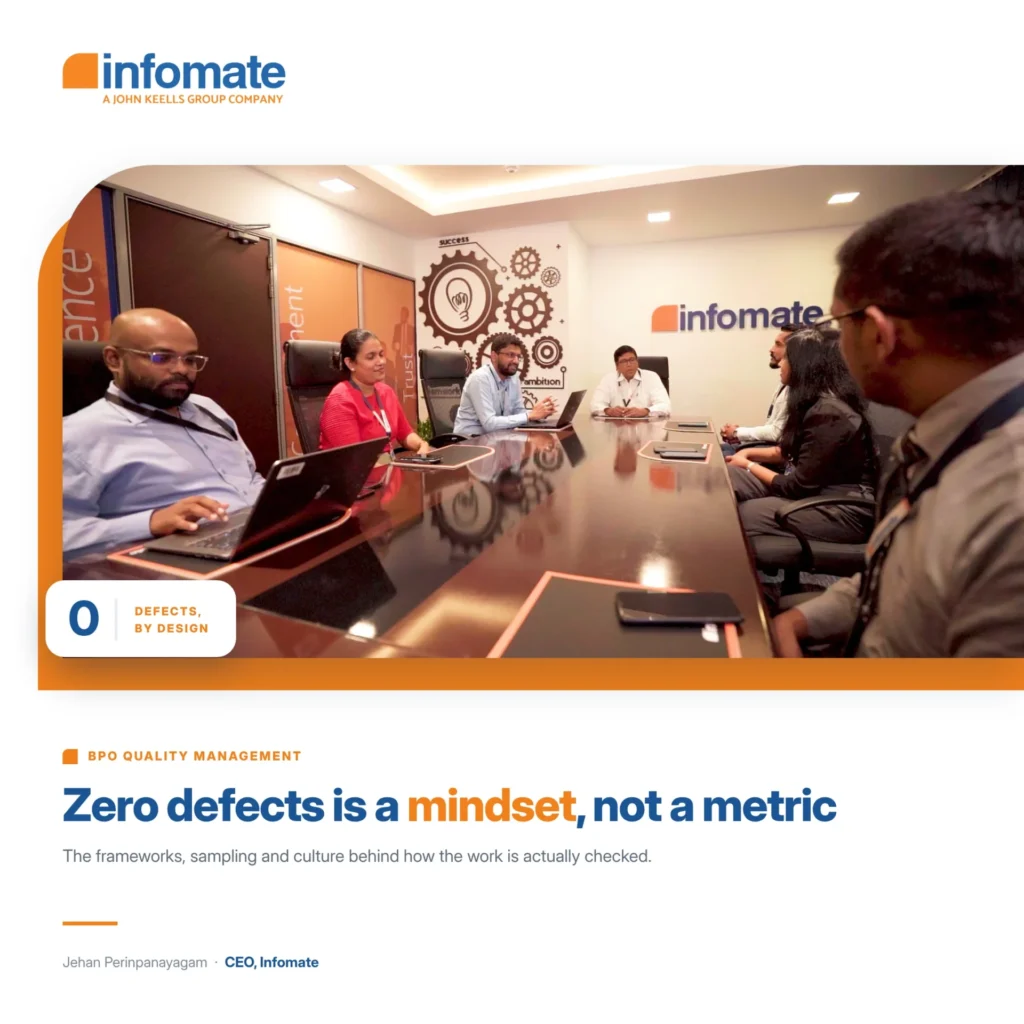
The principle I have returned to most often is zero defects. The concept originated with Philip Crosby, and it was the Japanese quality movement that adopted and developed it most thoroughly. What makes it powerful is that it is fundamentally a mindset shift. You stop being satisfied with 99.9% — because in financial processing, we cannot afford defects. Accepting a defect rate as normal is the decision that makes defects normal.
Technology, and keeping the human in the loop
Technology has always been central to how we approach this, and the most effective place to apply it is upstream.
The strongest controls are the ones built into the ERP system and into the process itself, before a defect has a chance to occur. A practical example: we actively promote PO-based invoices over non-PO invoices, because the control environment around a PO-based invoice is significantly better and the opportunities for defects are simply fewer. Preventing a defect is always cheaper than catching one.
Beyond the ERP, we bring in other tools to automate checks and to drive best practice consistently. We have rolled out bots, because a bot will carry out a function in the prescribed way, repeatedly, and is not subject to some of the failings people are prone to on a long or monotonous task.
But — and this is not a caveat, it is the design principle — it remains important to keep the human in the loop. What works is the right balance of technology and people, with each doing what it is genuinely better at. Automation handles repetition and consistency. People handle judgement, exceptions and understanding why the process exists at all.
Training and people: the foundation of BPO quality management
None of the above survives without the people running it, which is why training sits alongside process and technology rather than beneath them.
We have our own learning and development team and our own pool of trainers, covering both technical training and soft skills. The technical side matters for obvious reasons. The emphasis on rationale matters more than people expect: our teams are taught why they are doing what they are doing, not only how. Someone who understands the purpose of a control will notice when it stops making sense. Someone who only knows the steps will not.
We also work to keep people exposed to new thinking — current best practice, new ways of working, and the thinking coming out of leading universities and the wider BPO industry. Our senior team attends summits and conferences regularly, so the organisation stays close to the cutting edge of both general management knowledge and BPO-specific practice.
Quality, in the end, is a combination of all of it: a philosophy and a culture across the organisation, specific and documented processes, intelligent use of technology, and continuous training and learning. Remove any one and the others weaken.
Frequently asked questions
About the author
Jehan Perinpanayagam is Chief Executive Officer of Infomate (Pvt) Ltd. He has led the company through its growth from a captive shared services centre into an international business process management provider serving clients in the UK, the United States, Australia and the Middle East.
About Infomate
Infomate (Pvt) Ltd is Sri Lanka’s first shared services centre and a wholly owned subsidiary of John Keells Holdings PLC. Infomate delivers finance and accounting, HR and payroll, and customer experience services to clients across the UK, the United States, Australia and the Middle East, with deep SAP expertise built over two decades of multi-entity delivery. Infomate was the first accounting BPO in Sri Lanka to achieve ISO 27001 certification and is recognised in the Everest Group FAO PEAK Matrix®.