

By Jehan Perinpanayagam, CEO, Infomate (Pvt) Ltd
Backed by John Keells: Why Group-Level Governance Matters When You Outsource
Short answer: When choosing an outsourcing partner, most buyers compare price, talent and references — and stop there. The criteria that actually determine whether an engagement survives are harder to see on a proposal: financial stability, the ability to scale, certifications, leadership calibre, and whether the provider can keep investing in automation, facilities and staff retention over the life of the contract. A provider’s balance sheet is not a procurement detail. It is a risk control.
The transition that raised the question
We recently took over the work of an Australian company — a large global brand and the market leader in its space.
What surprised us was who had been doing the work. The incumbent provider was a very small, little-known player, and this client was the only BPO engagement that provider was supporting. A listed international business had placed its core processes with an operation that had no other comparable client to fall back on.
To their credit, the client took the responsible decision and moved the work to a stronger, more secure provider with better credentials. But the situation stayed with me, because it raises a question that too few organisations ask properly: what safeguards are actually in place when choosing an outsourcing partner?
What choosing an outsourcing partner actually puts at risk
This is not a routine procurement decision. You are opening up your company’s processes to another party, and you need to be confident of several things before you do.
Is the provider stable? Is this a business that could suddenly go under or declare bankruptcy, taking your month-end with it? Can they support your growth, and do they have the financial muscle to scale when you do? Can they sustain operations over years, not quarters — continuing to invest in automation, in facilities good enough to retain staff, in the capabilities your engagement will need in year three rather than year one?
Then there is the question of people. What is the credibility and calibre of their leadership? Can they support your strategic plans, or only your current volume?
Pricing matters. So do talent, track record and references — these are the things most buyers examine closely, and they are examined closely because they are easy to examine. But certifications, credibility, financial strength and the ability to scale belong on the same list, and they are the ones most often left off it.
The risk profile changes with the size of the partner
There is a second dimension to choosing an outsourcing partner, and I want to be careful here, because this is in no way intended to denigrate startups and smaller players. Some of them grow into large players, and they deserve support in doing so.
But if you are a listed company, or a relatively large one, you are looking for a commensurate partner — an equal, someone who can support your growth and de-risk your offshoring strategy rather than add to its risk.
Go with a smaller player and the risk profile rises immediately. You become exposed across several fronts at once, and you need very close and continuous monitoring of progress, of information security, of investment levels, of the financial health of the company itself and its ability to continue. The operation tends to be heavily dependent on specific individuals. And a change of leadership, or a falling-out between partners, can turn into a genuinely worrying period for your own operations — through no fault of your own and with very little warning.
That supervision burden is a real cost. It is rarely priced into the comparison that made the smaller provider look cheaper.
What group backing actually means
This is where our own position is relevant, and it is why I think it belongs in the conversation rather than in a brochure.
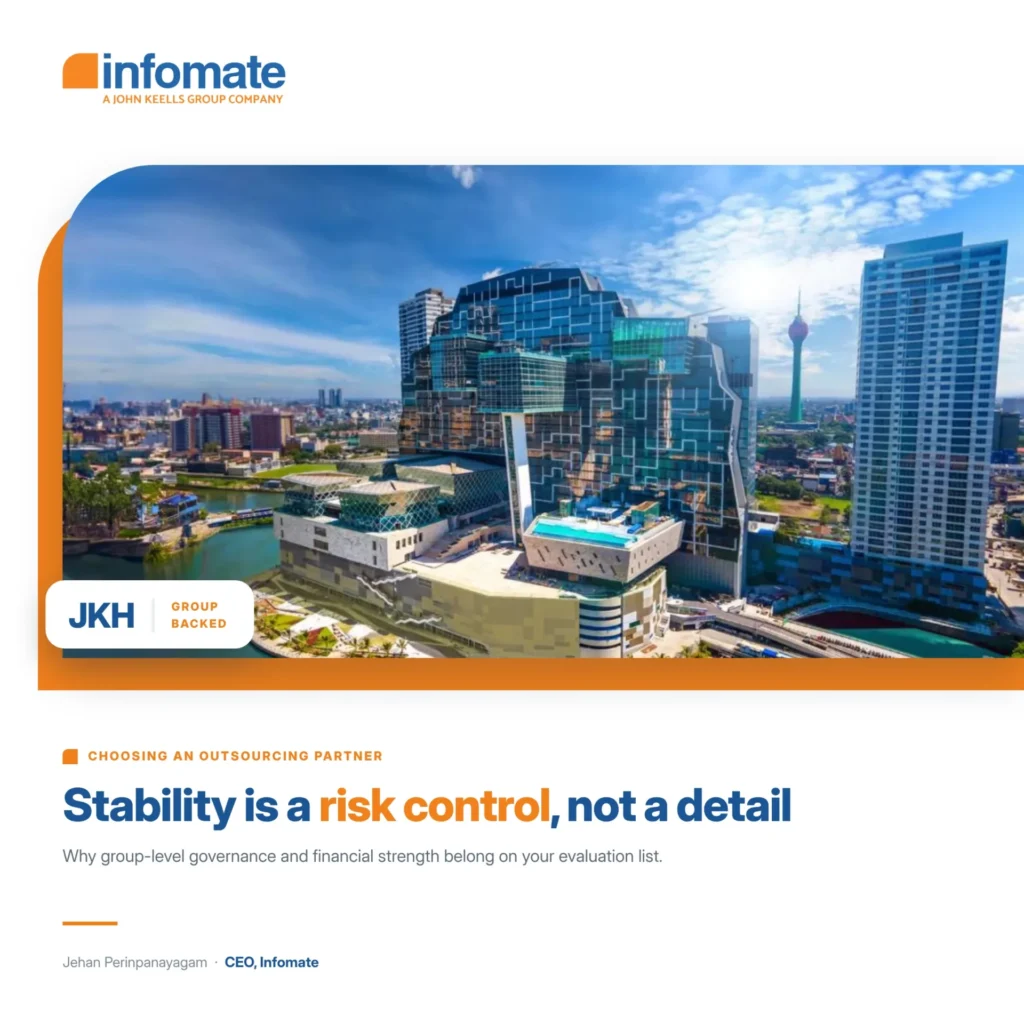
Infomate is backed by Sri Lanka’s leading conglomerate, John Keells Holdings. The group has a history stretching back around 150 years and has been voted the country’s most respected entity 20 times over the last 21 years. It carries a market capitalisation above a billion dollars, and it has attracted international investment, including from Citibank.
Its operating footprint tells the same story. More than a dozen large hotel properties in Sri Lanka and four in the Maldives. The largest private landowner in the city of Colombo. Its own airline. A stake in the Colombo port in partnership with the Adani Group and Maersk. Market leadership in supermarkets and consumer foods. Real estate. And in financial services, a substantial stake in one of Sri Lanka’s most successful banks. The group has built long-term joint ventures and partnerships with international brands including Maersk, Wendy’s and BYD.
The point of listing this is not scale for its own sake, and nor is size by itself a reason for choosing an outsourcing partner. It is what scale underwrites: a strong balance sheet, a long record of values and governance, international partnerships that bring their own compliance expectations, and the financial stability to keep investing through a downturn rather than retrenching during one.
For a client, that converts into something practical. The governance standards the group applies internally apply to us. The investment capacity sits behind our commitments. And the question of whether your provider will still be operating in five years simply does not arise.
Choosing an outsourcing partner: the questions worth asking
Whoever you ultimately select, these are worth putting on the table early.
Who owns the provider, and what is behind them financially? How many clients of comparable size do they support, and what happens to them if they lose one? What have they invested in over the last three years — automation, facilities, certification, training? What certifications do they hold, and can they produce the certificates with scope statements? How dependent is the operation on two or three specific individuals? And what would happen to your engagement if their leadership changed hands tomorrow?
Taking a decision to offshore is a significant one. When you make it, give adequate time and attention to ensuring you have a strong, stable, respected partner — one that shares your values, has the financial muscle and the ability to scale, and will keep your work secure and stable for as long as you need it.
Frequently asked questions
About the author
Jehan Perinpanayagam is Chief Executive Officer of Infomate (Pvt) Ltd. He has led the company through its growth from a captive shared services centre into an international business process management provider serving clients in the UK, the United States, Australia and the Middle East.
About Infomate
Infomate (Pvt) Ltd is Sri Lanka’s first shared services centre and a wholly owned subsidiary of John Keells Holdings PLC. Infomate delivers finance and accounting, HR and payroll, and customer experience services to clients across the UK, the United States, Australia and the Middle East, with deep SAP expertise built over two decades of multi-entity delivery. Infomate was the first accounting BPO in Sri Lanka to achieve ISO 27001 certification and is recognised in the Everest Group FAO PEAK Matrix®.