




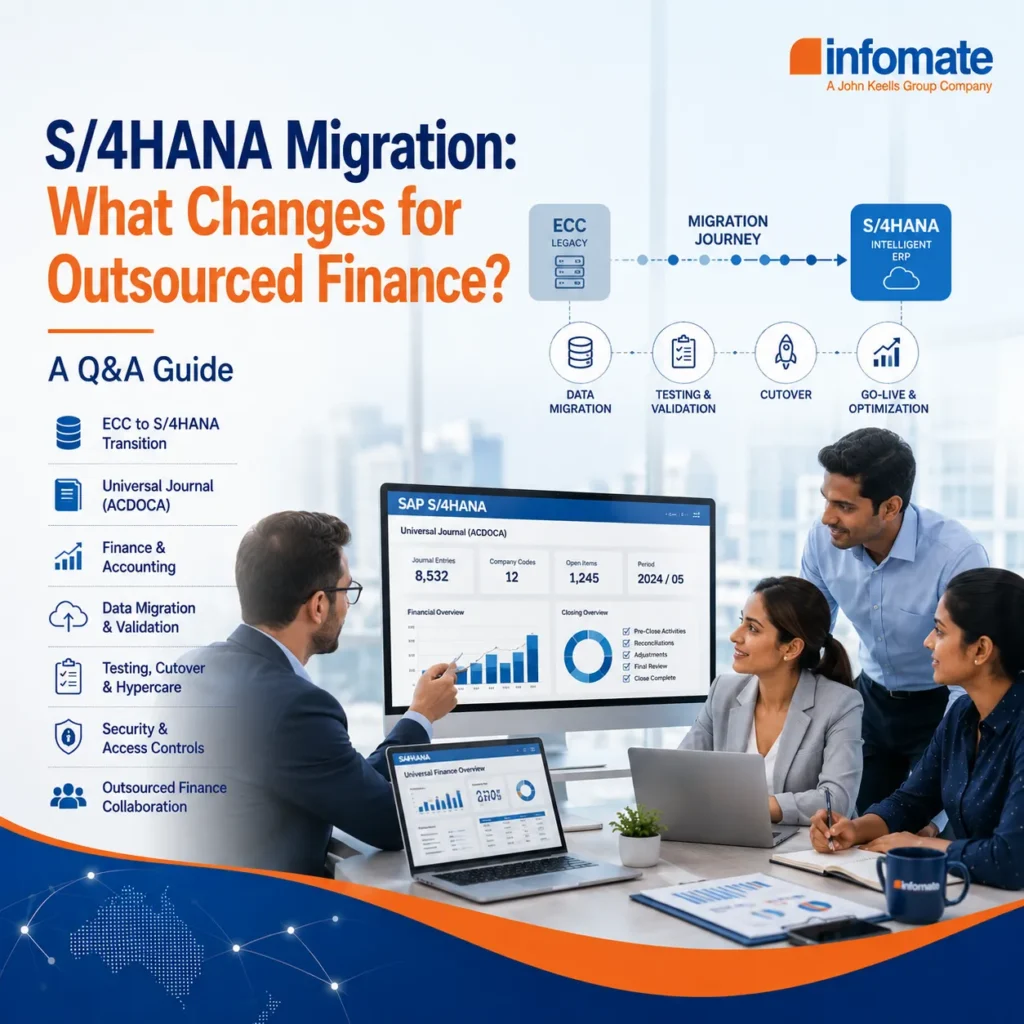
Every organisation still running SAP ECC has an S/4HANA migration somewhere on its roadmap — and for those whose finance processing sits with an outsourcing partner, the project raises questions that standard migration guides never answer. For businesses using SAP services, an S/4HANA migration outsourced finance project raises the same questions: Does the contract change? Who retrains whom? Migrate first or outsource first? This guide answers the questions finance leaders actually ask, in the order they usually ask them.
Quick answer: A migration changes the system your provider works in, not the logic of the outsourcing relationship. The Universal Journal collapses FI and CO into one data structure, familiar transactions merge or disappear, real-time processing shortens the close, and provider teams need retraining on Fiori workflows. Handled well, an experienced provider becomes an asset in the migration; handled badly, the migration is where undocumented process knowledge goes to die.
What is actually different in S/4HANA for day-to-day finance?
The deepest of the S/4HANA finance changes is the Universal Journal (table ACDOCA): financial accounting and controlling entries, which lived in separate structures in ECC, now post to a single line-item table. Reconciliation between FI and CO — a recurring close task in ECC — largely disappears because there is nothing left to reconcile. Related changes follow: customer and vendor master maintenance moves to the unified Business Partner, several classic transactions are replaced by Fiori apps, and material ledger and new asset accounting become mandatory. For processing teams, the daily work is recognisably similar; the data structures, screens, and a meaningful share of the close checklist are not.
Does an S/4HANA Migration Change Our Outsourcing Contract?
It shouldn’t change the commercial fundamentals, but it should trigger a scope conversation covering three items: transition support (testing, cutover, and hypercare effort is real work — agree how it’s charged), updated desktop procedures (everything referencing ECC transactions needs revision), and SLA terms for a defined stabilisation window with a hard end date. A provider who raises these topics before you do is demonstrating exactly the experience you want.
Should We Migrate First or Outsource First?
Experience favours outsourcing first, for one reason: documentation. A provider cannot take over a process without documenting it — desktop procedures, exception handling, close checklists — and that documentation is precisely what an ECC to S/4HANA transition needs and what most in-house teams don’t have written down. Companies that outsource first enter the project with processes mapped; companies that migrate first often discover mid-project that critical knowledge exists only in the heads of a busy in-house team. The counter-case: if your ECC environment is heavily customised and you intend to standardise radically, redesigning first and handing over clean processes is defensible. Either way, never run transition and cutover in the same month.
What Should Our Provider Be Doing During the S/4HANA Migration?
Five things: writing and executing test scripts for the processes they run (they know the edge cases better than anyone); validating migrated master data — vendor bank details above all; parallel running to compare ECC and S/4HANA outputs; rewriting desktop procedures for the new environment; and staffing hypercare, when transaction-level questions spike after go-live. If your provider has supported these migrations before, ask for their lessons-learned register — one of the genuine advantages of a partner who has seen the transition from both sides.
What Risks Are Specific to S/4HANA Migration Outsourced Finance?
Four recur. Authorisation redesign: S/4HANA role concepts differ from ECC, and provider access must be rebuilt without breaking segregation of duties — involve the provider in role design early. Interface breakage where the provider’s ancillary tools (workflow, OCR, reporting extracts) connect to the ERP. Knowledge gaps if the provider’s team was trained on your ECC quirks but not the redesigned processes — insist on training before cutover, not after. And split accountability: post-go-live issues invite finger-pointing between implementation partner, provider, and internal IT; a single triage owner and a shared defect log prevent most of it.
Will the S/4HANA Finance Close Actually Get Faster?
The technology removes real obstacles — FI/CO reconciliation, batch delays, manual reporting — so a one-to-two-day close improvement is a realistic ambition. But the improvement is earned in process redesign, not granted by software. A close that was undisciplined in ECC will be undisciplined in S/4HANA, just with better screens. Providers running closes for many clients tend to capture the gains, because they arrive with a mature close-calendar discipline to plug the new capabilities into.
Key takeaways
- The Universal Journal is the change that matters most: FI/CO reconciliation work largely disappears, and the close checklist changes with it.
- Treat the migration as a scope conversation with your provider, not a contract renegotiation.
- Outsourcing before migrating usually wins, because it forces the process documentation the migration will need.
- Involve your provider at design phase, before blueprint sign-off — transaction-level reality should inform design decisions.
Frequently asked questions
When Should We Involve Our Provider in Migration Planning?
At the design phase, before blueprint sign-off. As a minimum: provider review of future-state designs for every scope they operate, participation in master data cleansing decisions, and a named provider workstream lead inside the programme.
Do Provider Teams Need Formal S/4HANA Retraining?
Yes — on the Fiori workflows and changed close tasks for your specific design, delivered before cutover. Generic S/4HANA familiarity is not a substitute for training on your redesigned processes.
How Long Is a Reasonable Stabilisation Window?
Typically four to eight weeks of hypercare with defined exit criteria, after which standard SLAs resume in full.
Conclusion
An S/4HANA migration with outsourced finance is neither harder nor riskier than one without — it is simply a project with one more party, and one that can carry more of the load than most programmes ask of it. Bring the provider in early, agree the scope items up front, and use their documentation and testing capacity as the asset it is.
Planning a migration with outsourced processes in scope? Infomate, a John Keells Group company, operates finance and accounting processes inside client SAP environments — ECC and S/4HANA — and has supported clients through platform transitions across two decades of SAP-based delivery. Start the conversation at Infomate .