




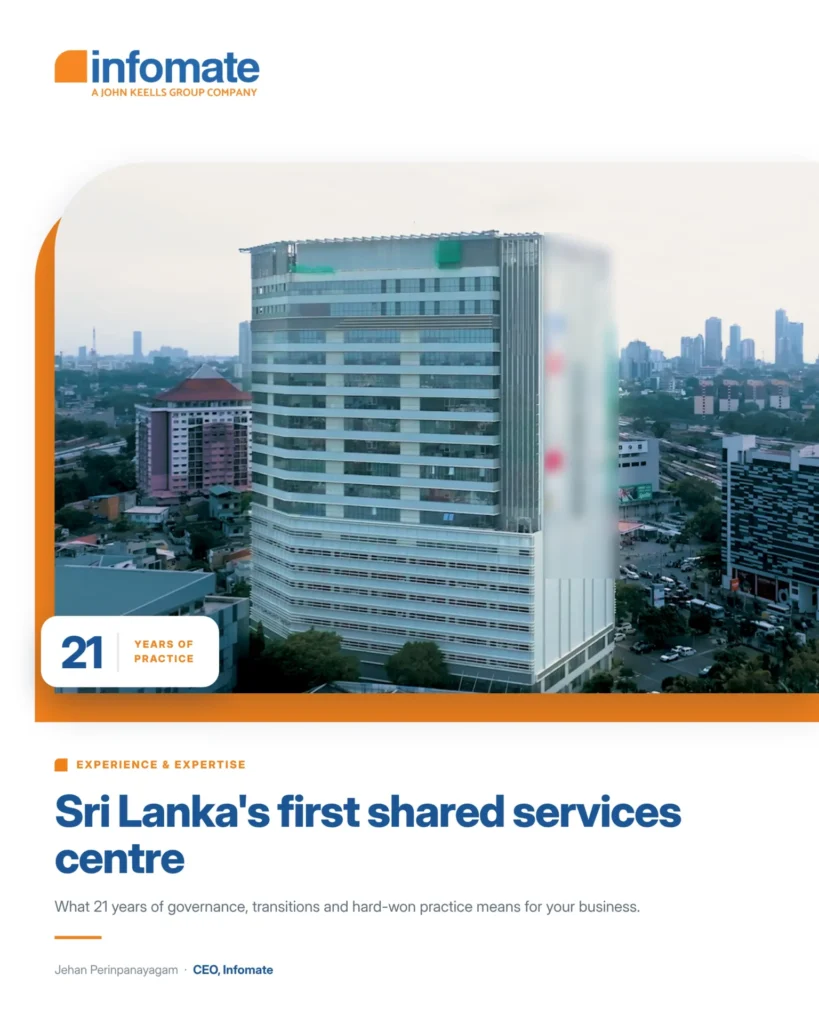
By Jehan Perinpanayagam, CEO, Infomate (Pvt) Ltd
Sri Lanka's First Shared Services Centre: What 21 Years of Experience Means for Your Business
Short answer: Infomate was the first shared services centre in Sri Lanka, and we are now in our third decade of operations. That tenure translates into three things a client can actually use: governance and control standards learned by serving one of the country’s most demanding conglomerates, a grounding in accounting fundamentals built in the pre-AI era, and a body of BPO practice — information security, team structure, automation, transition management — accumulated across two decades of client engagements. The value of experience is not sentiment. It is knowing what goes wrong before it goes wrong.
Where it began: the first shared services centre in Sri Lanka
Infomate started life as a captive operation for the John Keells Group. Being the first shared services centre in Sri Lanka was a distinction, but the more useful part was who we were serving.
The John Keells Group is a sophisticated, streamlined, deeply process-oriented organisation, and it is passionate about governance, controls and best practice. It insists on being world class, and it holds its service providers to that same line. As a captive, we had no option but to uplift our own standards to meet it.
That is an unusual way to grow up. Most outsourcing providers learn client standards gradually, client by client, with room to improve between engagements. We had to learn, adapt and conform to genuinely world-class standards from the outset, under a demanding internal customer who would notice if we did not.
Everything that came from that — ERP best practice, governance discipline, control mechanisms, process efficiency — is now part of what we bring to every client we serve. The standards were set by an exacting parent. The beneficiaries are our customers.
Two decades of fundamentals, in an era that is losing them
The second thing tenure gives you is depth in the basics, and this matters more now than it did ten years ago.
We grew up in the non-AI world. We had to learn accounting practice the hard way, in a different era, without tools that smooth over gaps in understanding. That gave us a solid foundation: we know that reconciliations are done properly because we understand the underlying logic, the underlying accounting principles, and exactly how the work is performed at a granular level.
What we are observing now, with newer entrants to the industry, is that this grounding is often missing. The tools are available to everyone. The understanding beneath them is not.
This leads to the one general caution I would offer any business evaluating finance or back-office support right now, whoever they ultimately choose. Understanding and control of the process must never be lost, and it must always be retained by humans. Automation should sit on top of a process that people genuinely understand. Where it substitutes for that understanding, the organisation has acquired speed and given up control — and it usually does not discover the trade until something fails.
A provider that learned the work before the tools existed can use the tools well. A provider that only ever knew the tools has nowhere to stand when they fall short.
What 21 years of client engagements actually teaches
There is a factor here that no amount of capability-building can shortcut: sheer years.
Working with clients across more than two decades, across different continents and different industries, teaches you things that do not appear in a methodology document. What can go wrong in a transition. What goes wrong in a client engagement, and at which point. Where the real risks sit in any given process. How to fine-tune an SLA so it measures something that matters rather than something convenient. Where the opportunities for improvement usually hide.
That is a rich pool of knowledge, and it has been assimilated into the company over time. It is part of our intellectual property and, more accurately, part of our DNA. It did not come cheaply or easily — it came the hard way, which is the only way it comes.
The point of holding it is to share it. We put it in front of our clients freely, because a transition that avoids the known pitfalls is worth more to them than a transition that discovers each one in sequence.
Firsts that became infrastructure
The third element is BPO practice itself — how to structure a team, how to run information security, which automation tools to apply and where. This too was hard-won, and in several cases we had to build it because nobody in the market had built it yet.
We were the first accounting BPO in Sri Lanka to secure ISO 27001 certification. We were the first Sri Lankan BPO to be listed in the Everest Group PEAK Matrix®. And when we needed a document management system that met the standard our work required, we built our own — a system we consider world class, and which has served our clients for years since.
None of these were badges collected for a brochure. Each one was built because the work demanded it, and each one is now infrastructure that a client inherits on day one of an engagement rather than something they have to wait for us to develop.
Choosing a shared services centre in Sri Lanka: what experience should mean
If you are evaluating a shared services centre in Sri Lanka, or anywhere else, experience is worth testing rather than taking on trust. A few questions separate a provider who has accumulated knowledge from one who has simply accumulated years.
Ask what they learned from their most difficult transition, and listen for specifics. Ask who sets their standards, and what happens when a client’s standard is higher than their own. Ask how their people are trained in the fundamentals, not just in the tools. Ask what they have built themselves, as opposed to bought. And ask what they would tell you not to outsource.
Our own position on that last question is straightforward. Our goal is not simply to grow. It is to make a difference to our customers — to be genuinely invested in their processes, to help them become world class in their own operations, and to be partners in their progress rather than a vendor at the end of a service line.
After 21 years, that is what the experience is for.
Frequently asked questions
About the author
Jehan Perinpanayagam is Chief Executive Officer of Infomate (Pvt) Ltd. He has led the company through its growth from a captive shared services centre into an international business process management provider serving clients in the UK, the United States, Australia and the Middle East.
About Infomate
Infomate (Pvt) Ltd is Sri Lanka’s first shared services centre and a wholly owned subsidiary of John Keells Holdings PLC. Infomate delivers finance and accounting, HR and payroll, and customer experience services to clients across the UK, the United States, Australia and the Middle East, with deep SAP expertise built over two decades of multi-entity delivery. Infomate was the first accounting BPO in Sri Lanka to achieve ISO 27001 certification and is recognised in the Everest Group FAO PEAK Matrix®.