




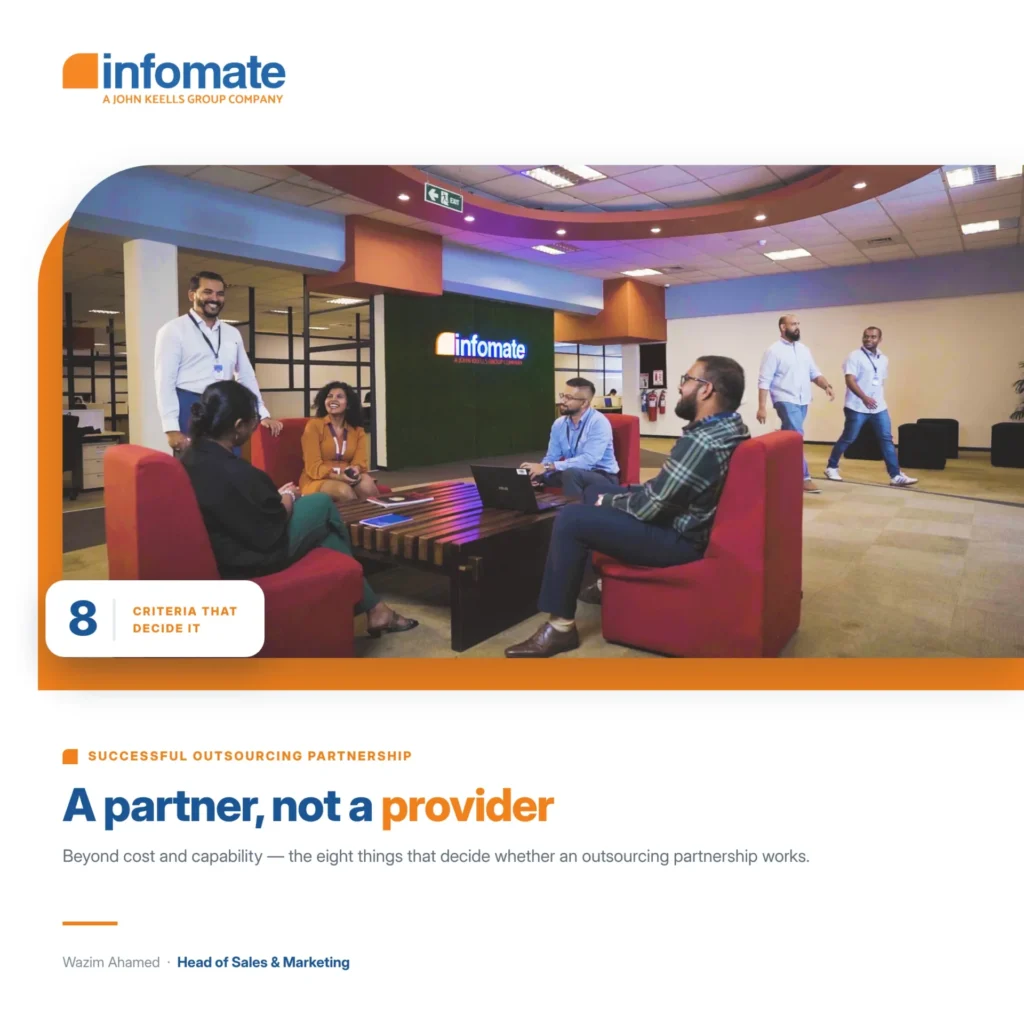
By Wazim Ahamed, Head of Sales and Marketing, Infomate (Pvt) Ltd
Beyond Cost and Capability: What Makes an Outsourcing Partnership Truly Successful?
Short answer: A successful outsourcing partnership is decided by eight things, and price is only one of them: infrastructure and business continuity, governance with genuine senior leadership involvement, data security and compliance, a considered approach to technology and AI, access to talent and process expertise, sustainable rather than headline cost efficiency, employee wellbeing and responsible business practice, and independent industry recognition backed by a real track record. Organisations today are not looking for a service provider. They are looking for a partner who understands their business and is accountable for its success.
Why outsourcing is no longer a cost decision
A successful outsourcing partnership is no longer built on cost reduction alone. As businesses navigate increasing competition, digital transformation and changing customer expectations, the value of an outsourcing partner is increasingly measured by its ability to deliver operational excellence, embrace innovation and contribute to long-term business growth.
Organisations today are looking for more than service providers. They need partners who understand their business, demonstrate accountability, protect their interests and continuously seek ways to create value.
So what should businesses actually look for in a successful outsourcing partnership?
Eight marks of a successful outsourcing partnership
1. World-class infrastructure and business continuity
The right infrastructure is fundamental to delivering consistent and reliable services. Modern, secure and technology-enabled facilities should support productivity, collaboration, employee wellbeing and business continuity.
Beyond the physical environment, operations across multiple locations offer greater flexibility, access to wider talent pools and operational resilience. Clients should look for partners whose infrastructure is designed to meet international standards and accommodate evolving business requirements.
2. Strong governance and leadership accountability
Effective governance is one of the most important foundations of a successful outsourcing partnership. It should extend beyond operational reviews and service-level reporting to include active senior leadership involvement.
Regular weekly and monthly governance engagements provide opportunities to assess performance, address challenges, identify improvements and maintain alignment with business objectives.
Importantly, senior management — including the CEO — should remain connected to client relationships. This demonstrates accountability at the highest level and reinforces the understanding that the client’s success is a shared responsibility.
3. Data security and compliance
When outsourcing business-critical functions, organisations must have confidence that their financial, customer and commercially sensitive information is protected.
A credible partner should demonstrate robust information security policies, access controls, risk management and clearly defined data protection practices.
Internationally recognised standards such as ISO/IEC 27001 provide an important benchmark for information security management. But security must go beyond certification and become part of everyday operations, supported by employee awareness, continuous monitoring and appropriate controls.
4. Technology, automation and AI
Technology is reshaping the outsourcing industry. Automation and artificial intelligence are creating opportunities to streamline processes, improve accuracy, reduce manual intervention and enhance productivity.
An effective outsourcing partner should be willing to embrace new technologies and identify practical opportunities to integrate them into existing business operations.
Technology adoption should be driven by business value rather than trends alone. The ability to combine automation and AI with human expertise, while maintaining appropriate governance and security, will increasingly distinguish leading providers from the rest.
5. Access to world-class talent and process expertise
One of the greatest advantages of outsourcing is access to a wider pool of skilled professionals without the need to build and maintain the same capabilities internally.
Markets such as Sri Lanka offer access to talented professionals across finance and accounting, procurement, customer service, IT support and data management.
Beyond recruitment, the right partner must be able to develop and retain that talent through structured training, professional development and effective leadership.
Experience across multiple ERP platforms — including SAP, Oracle and Microsoft Dynamics — is another valuable advantage. It enables outsourcing teams to adapt to different client environments, understand established workflows and integrate into existing operating models.
6. Sustainable cost efficiencies
Cost optimisation remains an important driver of outsourcing, but the focus should be on sustainable savings that do not compromise quality, security or operational control.
The right partner should deliver value through competitive talent markets, improved resource utilisation, process standardisation, automation and operational scalability.
Businesses should look beyond the initial price and consider the total cost of ownership, productivity improvements and the long-term efficiencies generated through the partnership.
7. People, wellbeing and responsible business
People remain at the heart of every successful outsourcing operation. An engaged and motivated workforce is more likely to demonstrate ownership, deliver consistent service and build meaningful client relationships.
Employee wellbeing should therefore be a strategic priority, supported by active HR engagement calendars, recognition initiatives, wellness programmes, learning opportunities and an inclusive workplace culture.
Equally important is the wider social impact of outsourcing. In countries such as Sri Lanka, rural BPO initiatives can create meaningful employment outside major cities, helping individuals develop professional skills, build sustainable livelihoods and contribute to regional economies.
ESG should also be embedded in everyday business practice — responsible governance, environmental awareness, biodiversity and social inclusion. Commercial success and positive social impact should go hand in hand.
8. Industry recognition and long-term partnership
A provider’s track record and independent industry recognition offer additional confidence when evaluating potential partners. Assessments such as Everest Group’s PEAK Matrix® provide an external perspective on a provider’s capabilities and market positioning.
Recognition alone is not enough. Experience, transparency, adaptability and a demonstrated commitment to continuous improvement matter just as much.
Ultimately, a successful outsourcing partnership is built on mutual trust and a shared commitment to long-term success. Business requirements evolve, and partners must be capable of adapting while maintaining service quality and operational stability.
What a successful outsourcing partnership looks like at Infomate
These are the principles that should guide any organisation selecting a long-term outsourcing partner. They are also the standards we hold ourselves to.
Our facilities in Colombo and Kurunegala, our ISO 27001 certification, senior leadership involvement in client governance and our focus on process excellence reflect a commitment to delivering consistent and secure services.
We continue to embrace technology, automation and AI while developing expertise across multiple business processes and ERP environments. Equally important is our investment in employee wellbeing and in creating a workplace people want to stay in.
Through three rural BPO centres, we contribute to regional employment and livelihoods, reflecting a wider commitment to ESG, biodiversity and inclusive economic development.
Our recognition in Everest Group’s PEAK Matrix® for two consecutive years, 2025 and 2026, marks another milestone in our journey as a Sri Lankan BPM provider.
As the global outsourcing industry continues to evolve, the distinction between a service provider and a true business partner will only become more important.
Great outsourcing is not just about cost savings or transferring processes. It is about trust, accountability, innovation, people and a shared commitment to creating lasting value.
Frequently asked questions
About the author
Wazim Ahamed is Head of Sales and Marketing at Infomate (Pvt) Ltd, working with clients across the UK, the United States, Australia and the Middle East on finance and accounting, HR and payroll, and customer experience outsourcing.
About Infomate
Infomate (Pvt) Ltd is Sri Lanka’s first shared services centre and a wholly owned subsidiary of John Keells Holdings PLC. Infomate delivers finance and accounting, HR and payroll, and customer experience services to clients across the UK, the United States, Australia and the Middle East, with deep SAP expertise built over two decades of multi-entity delivery. Infomate was the first accounting BPO in Sri Lanka to achieve ISO 27001 certification and is recognised in the Everest Group PEAK Matrix®.