




By Jehan Perinpanayagam, CEO, Infomate (Pvt) Ltd
Short answer: Hotel CFOs are being squeezed from both ends — revenue that moves with events entirely outside their control, and a cost base that barely moves at all. On top of that sits a heavier reporting burden from owners, faster compliance cycles, constant scenario modelling, and now an expectation to show progress on AI. Most finance teams are being asked to absorb all of it without additional headcount. A specialist outsourcing partner addresses several of these pressures with a single decision: it removes repetitive workload, imports process and ERP expertise, strengthens data governance, and lowers cost at the same time.
An industry exposed to everything
The hospitality industry continues to face unpredictability and global headwinds, and it remains unusually susceptible to events entirely outside the direct control of any operator. The Iran conflict, changes to flight schedules, and the economic pressure now gripping many economies all land on the same place — the forecast.
Travel, and particularly international travel, tends to be among the first casualties when conditions tighten. That alone would be difficult. What makes it harder is the structure of the industry itself.
Hospitality is heavily capital-expenditure intensive. It requires substantial investment up front and then regular infusions of capital for upgrades, refurbishments and brand-standard compliance. Set that heavy, continuing investment against real uncertainty in demand, and the core problem comes into focus: maintaining a consistent return on investment when occupancy is variable and the fixed cost base is, in practice, immovable.
The industry data bears this out. HVS reports that total compensation in accommodation and food services rose 26.5% between 2020 and 2024 — faster than inflation over the same period — with labour remaining the largest single expense line on a hotel P&L. Gross operating profit margins have been falling across property types, and in most markets RevPAR growth is now trailing inflation. Growth, where it exists, is coming from rate rather than added demand.
For a CFO, that combination is the whole job in one sentence: more cost, flatter demand, and no corresponding relief on the investment side.
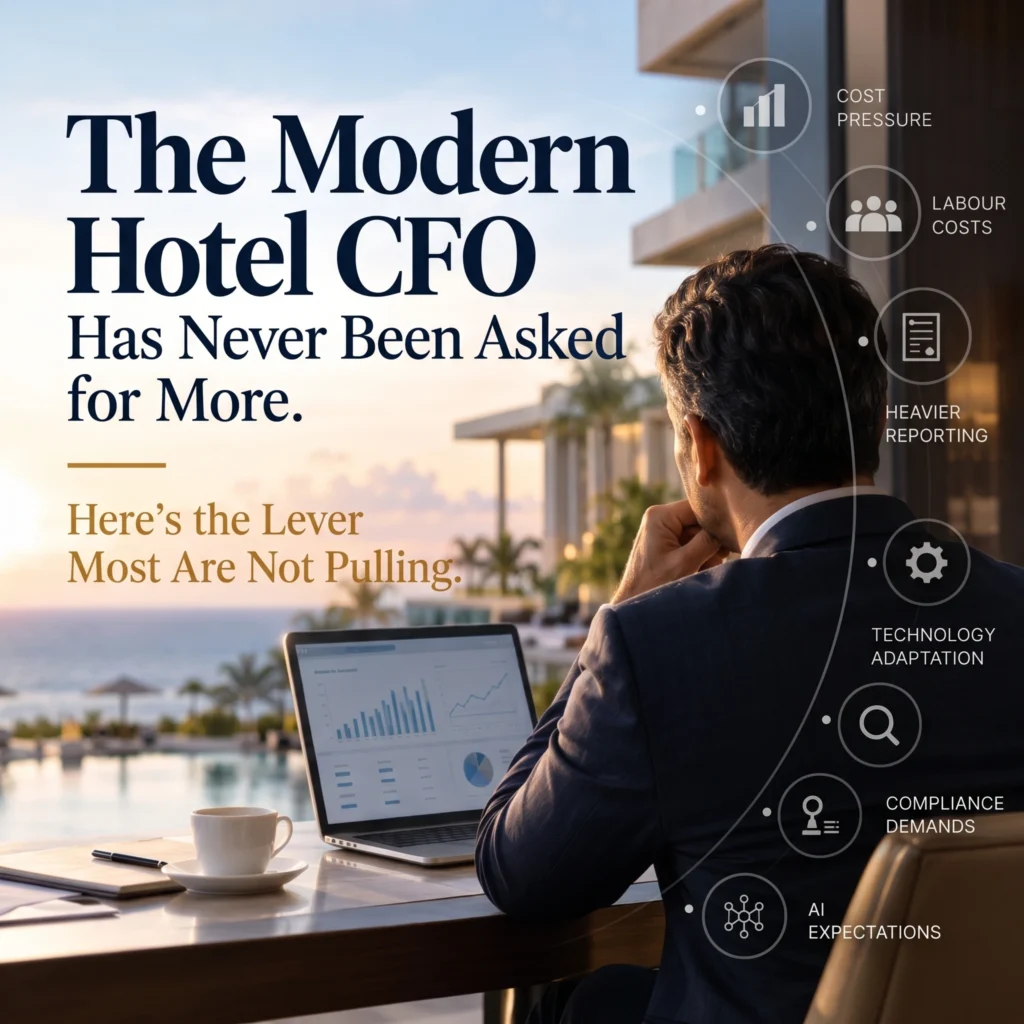
Four pressures arriving at once
The financial squeeze would be manageable in isolation. It is not arriving in isolation.
- Technology adaptation. Systems need to be adopted, integrated and made to work across properties — often while the existing environment is still being stabilised.
- A faster governance and compliance cycle. Queries arrive more frequently, with shorter turnaround expectations and a lower tolerance for late answers.
- Heavier owner reporting. Owners and asset managers want more reporting, in more detail, more often. Departmental performance, labour productivity, allocation transparency — all of it, regularly.
- Continuous scenario modelling. Margin tracking, what-if analysis and modelling across multiple demand scenarios have moved from an annual budgeting exercise to something close to a standing requirement.
And then, capping all of it, the AI wave — where CFOs are expected to demonstrate both progress and adaptability, frequently without a dedicated budget or team to deliver it.
These demands are being made of finance functions that typically have limited bandwidth and limited staffing. The asks are increasing. The resources are not. That is the real condition of the modern hotel CFO’s role, and it is a demanding one.
The lever: a specialist outsourcing partner
One of the areas we have seen make a material difference is working with a good outsourcing partner — and not simply as a cost measure.
The immediate effect is that repetitive workload transfers to the delivery partner. That alone returns bandwidth to a finance team that has none to spare. But the more interesting value sits alongside it.
A capable provider brings expertise the hotel group would otherwise have to hire or buy: process mapping, practical use of technology, and ERP best practice developed across multiple client environments. Outsourcing becomes a route to import those skills rather than build them from scratch internally.
Offshore delivery is cost-effective by nature, so the saving is real — but it arrives bundled with everything else. With one decision, a CFO gains access to talent, achieves cost efficiency, and receives immediate support on processes, process mapping, best practice and technology direction.
There is a fourth benefit that is consistently underweighted in evaluations. Offshoring providers bring real competence in data protection, information security and data governance — because these are inherent requirements of their own industry. A provider operating to those standards daily can share that discipline with a client whose own environment may be less formalised. For a hotel group handling guest-linked financial data across multiple properties and jurisdictions, that transfer of practice has real value.
Why this belongs on the agenda before year-end
Offshoring represents a factor that CFOs must now actively consider. It belongs in the toolbox — in the toolkit — alongside the other levers available for protecting margin and expanding capacity.
The practical recommendation is straightforward. In the remaining months of 2026, have the conversation with a back-office service provider — specifically a specialist provider with real experience in the hotel industry. Explore what is possible. Then form a strategy around it.
It is also, in our experience, an unusually easy case to make upward. The proposition has substantial upsides and very few downsides, which means owners and operators tend to be convinced quickly once the detail is in front of them.
What we have seen first-hand
We have worked with the Cinnamon chain of hotels for more than twenty years, and Sri Lanka has been at the forefront of a great many of these challenges — destination challenges over the years, and more recently the disruption to travel caused by the Iran war. Through all of it, Cinnamon Hotels has found that outsourcing gives it flexibility, the ability to adapt to situations quickly, and the capacity to keep exploring new technology, new services and new reporting alongside a delivery partner rather than alone.
Over the last four to five years we have also partnered with two UK-based hotel groups who are seeing considerable value in the relationship — and who increasingly treat their offshore partner as a strategic partner in their own evolution, rather than as a processing vendor.
The pattern across all of them is consistent. The hotel groups that have been proactive about using offshore delivery centres have been able to reap the benefits, and those relationships have tended to deepen rather than plateau. Hospitality has become a vital pillar within our wider offshoring services, and our pipeline of discussions with hotel groups in several parts of the world reflects that.
Frequently asked questions
What are the biggest challenges facing hotel CFOs right now?
Maintaining consistent return on investment when occupancy is variable and fixed costs are immovable, in a capital-intensive industry exposed to events outside its control. Alongside that: technology adaptation, a faster governance and compliance cycle, heavier owner reporting, continuous scenario modelling, and an expectation to demonstrate progress on AI — usually without additional headcount.
Can hotel finance functions be outsourced?
Yes. Repetitive and transactional workload transfers well to a specialist delivery partner, while commercial judgement, approval authority and ownership of the numbers stay with the hotel group’s own finance leadership.
What does a hotel group gain from outsourcing besides cost savings?
Access to talent, process mapping and ERP best practice, practical technology input, and competence in data protection, information security and data governance — all from a single decision.
Why does industry-specific experience matter in an outsourcing provider?
Hotel finance has its own rhythm and structure — daily revenue posting, departmental reporting, seasonality, multi-property allocations. A provider without hospitality experience will process the ledger competently and still produce reporting your general managers cannot readily use.
When should a hotel CFO start this conversation?
Before year-end. Have the discussion with a specialist provider, explore the options, and form a strategy — so that the arrangement is in place before the next pressure cycle rather than during it.
About the author
Jehan Perinpanayagam is Chief Executive Officer of Infomate (Pvt) Ltd. He has led the company through the growth of its finance and accounting, HR and customer experience delivery for clients in the UK, the United States, Australia and the Middle East, and has overseen more than two decades of SAP-based finance delivery for the hospitality sector.
About Infomate
Infomate (Pvt) Ltd is a Sri Lanka-based business process management company and a wholly owned subsidiary of John Keells Holdings PLC. Infomate delivers finance and accounting, HR and payroll, and customer experience services to clients across the UK, the United States, Australia and the Middle East, with deep SAP expertise built over two decades of multi-entity delivery. Infomate is recognised in the Everest Group FAO PEAK Matrix® and was Sri Lanka’s first ISO 27001-certified accounting BPO.