




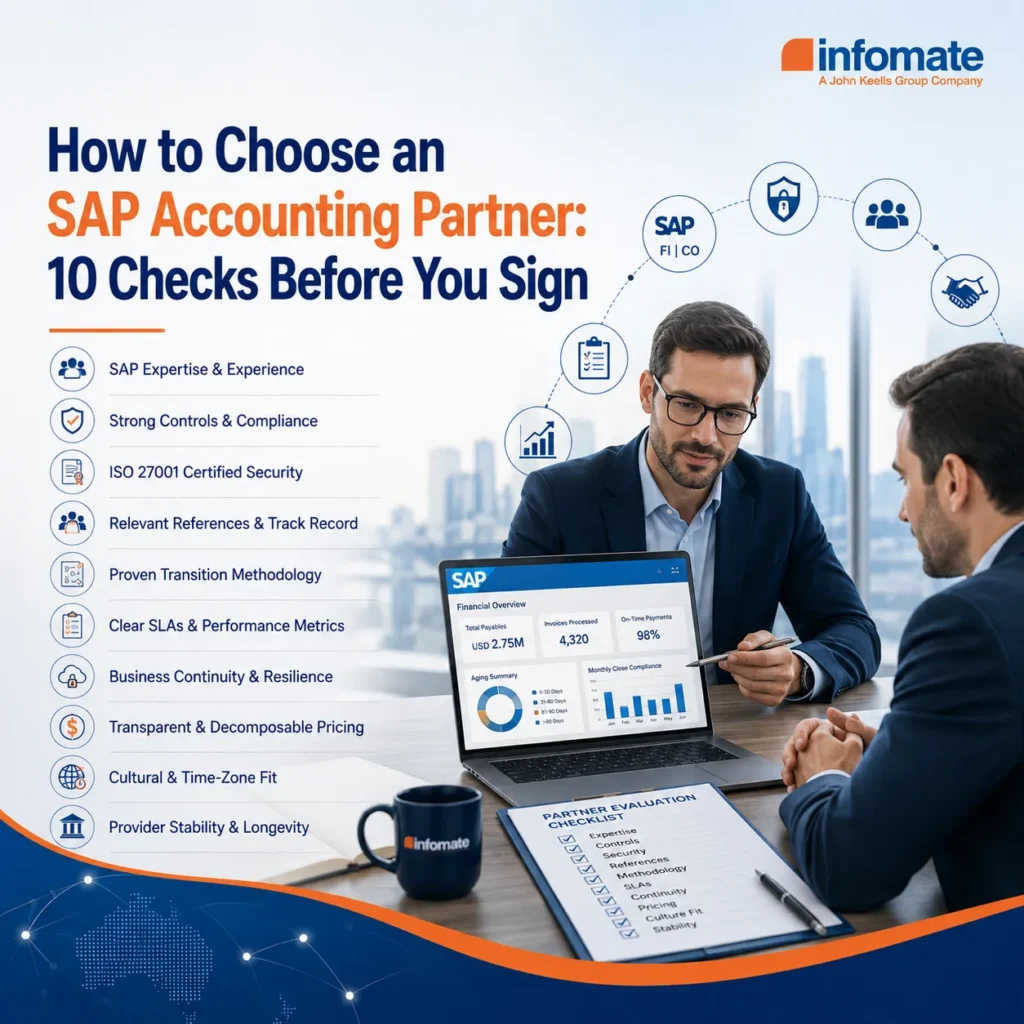
Outsourced finance fails less often because the provider is dishonest than because the buyer checked the wrong things — brand, price, and polish instead of controls, depth, and evidence. Selecting an SAP accounting partner who will process inside your SAP environment deserves a more rigorous method. This article gives you one: ten verifiable checks, in the order they should carry weight, plus the questions that reveal in minutes whether a provider genuinely knows SAP or merely markets it.
Quick answer: Run ten checks – SAP depth, control thinking, ISO 27001 certification, references with your shape, transition methodology, meaningful SLAs, verifiable continuity, decomposable pricing, cultural and time-zone fit, and provider stability. If a provider clears all ten, engagement risk is low. If they stumble on the first three, stop there.
The 10 Checks for Choosing an SAP Accounting Partner
1. Verify SAP Depth, Not ERP Familiarity
Ask which SAP modules the provider’s teams work in daily (FI, CO, MM invoice verification, asset accounting), which versions (ECC, S/4HANA), and how many staff hold hands-on transaction experience versus “exposure.” A partner who processes inside SAP every day answers in specifics — transaction codes, workflow variants, close tasks. Generic answers about “ERP capability” are a warning sign.
Understanding whether a provider can help organisations get the full value from their existing SAP environment is an important part of SAP outsourcing provider selection. Infomate explores this further in its article on unlocking the untapped power of SAP.
2. Test Their Control Thinking
Ask one question: “How do you ensure the person maintaining vendor master data can’t approve a payment?” A strong provider explains role design, SAP authorisation concepts, and how they evidence segregation of duties to auditors. This single question separates providers who understand controls from those who understand data entry.
This is particularly important because SAP segregation of duties is designed to reduce the risk of errors and fraud by distributing responsibilities and access rights across different users. Common control weaknesses are also covered in Infomate’s guide to SAP finance mistakes and how to spot them.
3. Require ISO 27001 Certification and Read the Certificate
For a partner handling financial and payroll data, an independently audited information security management system should be an entry criterion. Check that the certificate’s scope covers the services you’re buying, its expiry date, and the issuing body’s accreditation.
4. Ask for references with your shape, not your logo.
The useful reference is a client of similar size, entity count, and SAP complexity — ideally one who has been through a year end audit with the provider. Ask two things: what went wrong in the first six months, and how the provider handled it.
5. Inspect the transition methodology.
Good providers show a documented method: process discovery, desktop procedures, knowledge transfer, parallel running, cutover criteria, and hypercare — with a realistic timeline for a scope like yours. Vague transition plans produce the failures that get blamed on “outsourcing” generally.
6. Insist on SLAs that measure what you care about.
Accuracy rates, invoice turnaround, close-calendar adherence, and query response times, with monthly reporting and a named escalation path. Be wary of providers who resist measurement — and equally of those who promise perfection.
7. Verify business continuity physically, not verbally.
Backup power, redundant connectivity, tested recovery plans, cross-trained staff. Ask when the last continuity test ran and what it found. If you can, spend an hour on the operations floor — it tells you more than any deck.
8. Demand pricing you can decompose.
Whether per-FTE, per-transaction, or fixed-fee, you should understand what drives the number and what happens when volumes change. Opaque pricing invariably resurfaces as scope disputes in month seven.
For a closer look at how outsourced SAP finance costs compare with an internal team, see Infomate’s SAP FI/CO outsourcing cost comparison.
9. Weigh cultural and time-zone fit.
Working-hours overlap with your finance calendar, English proficiency at team level, and a working culture your retained staff can collaborate with daily. Sri Lankan providers, for example, sit at a time-zone midpoint allowing same-day overlap with both European and Australian business hours — practical details like this shape the daily experience more than contract terms do.
10. Check the provider’s own stability.
Ownership, years in operation, client tenure, attrition. A provider backed by a listed group, with clients who have stayed a decade or more, carries less continuity risk than a well-marketed newcomer. Long average client tenure is the most honest statistic in this industry — it cannot be faked.
How to Run Your SAP Outsourcing Provider Selection Process
Shortlist three providers and score them against the ten checks, weighting checks 1–3 highest: SAP depth, control thinking, and certified security are the foundations everything else stands on. Evaluate price last — a cheaper provider who fails check 2 is not cheaper.
Key takeaways
- Depth, controls, and certified security come first; price comes last.
- One control question — vendor creation vs. payment approval — reveals more than a capability deck.
- References should match your size and complexity, not impress with logos.
- Client tenure is the industry’s most honest statistic; ask for it directly.
Frequently Asked Questions About Choosing a BPO Partner
How long should selecting a partner take?
Six to ten weeks for a diligent process: shortlisting, scored evaluation, reference calls, a site visit or virtual walkthrough, and contracting. Compressing this usually costs more time later in transition.
Should we pilot before committing?
Where practical, yes — a limited scope such as one entity’s accounts payable proves the working model before full transition. Established providers welcome pilots; reluctance is informative.
Is a large global provider safer than a specialist?
Not inherently. Scale brings resources, but mid-sized specialists often provide senior attention and flexibility that global providers reserve for their largest accounts. The ten checks matter more than provider size.
What contract length is reasonable?
Three years is common, with review clauses and documented exit-assistance provisions built in regardless of term.
Do these checks apply to non-SAP environments?
Almost entirely — substitute the platform in check 1 and the rest is platform-agnostic.
Conclusion: Choosing the Right SAP Accounting Partner
A disciplined selection process is the cheapest insurance an outsourcing engagement can buy. The ten checks above take weeks; recovering from a partner who fails them takes years. Choose on evidence, weight controls above cost, and let providers demonstrate depth rather than describe it.
Evaluating partners now? Infomate, a John Keells Group company, has provided SAP based finance and accounting outsourcing for two decades and was the first Sri Lankan accounting BPO certified to ISO 27001. Put us through all ten checks and learn more about how Infomate helps businesses get more from SAP ERP systems